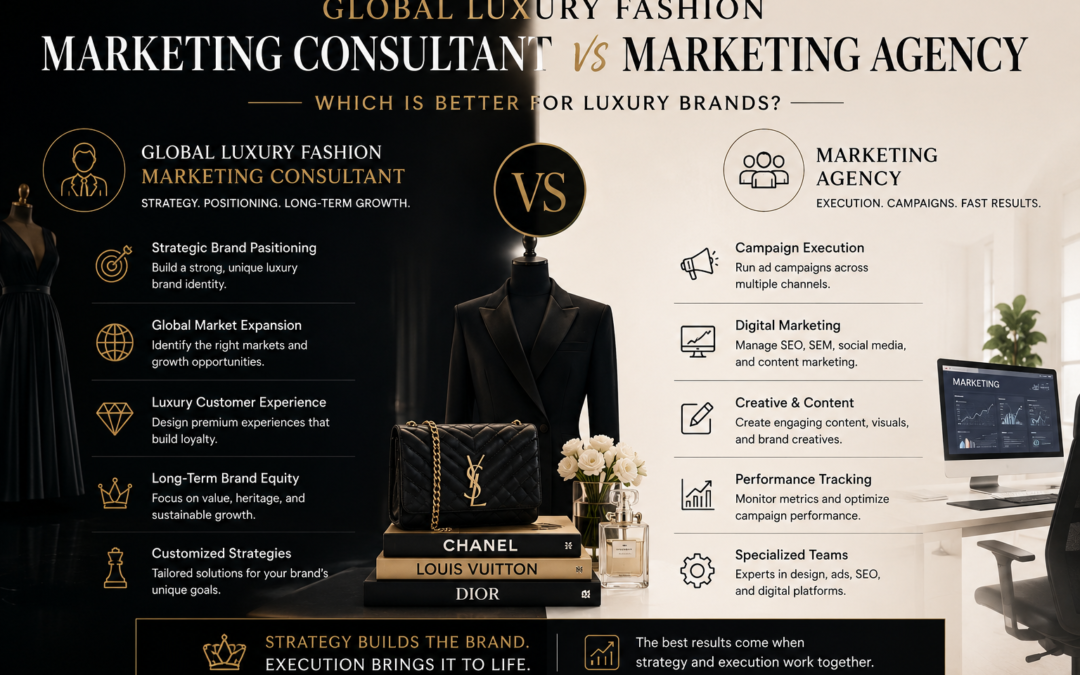
A Global Luxury Fashion Marketing Consultant is often the better choice for luxury brands that need strategic direction, premium brand positioning, international expansion, and long-term brand equity. A marketing agency is usually better suited for executing campaigns such as paid advertising, content creation, social media management, and website development. The right choice depends on whether your brand needs strategy, execution, or both.
Contents
- 0.1 Introduction
- 0.2 What Does a Global Luxury Fashion Marketing Consultant Do?
- 0.3 What Does a Marketing Agency Do?
- 0.4 Global Luxury Fashion Marketing Consultant vs Marketing Agency
- 0.5 When Should You Choose a Global Luxury Fashion Marketing Consultant?
- 0.6 When Should You Choose a Marketing Agency?
- 0.7 Can Luxury Brands Benefit from Both?
- 0.8 Final Verdict
- 1 Frequently Asked Questions
Introduction
Luxury fashion is unlike any other industry.
A luxury brand is not built by advertising alone. It is built through craftsmanship, heritage, exclusivity, customer experience, and consistent storytelling. Every decision—from pricing and packaging to digital campaigns and boutique experiences—shapes how customers perceive the brand.
As luxury brands grow into international markets, one question becomes increasingly important:
Should you hire a Global Luxury Fashion Marketing Consultant or work with a marketing agency?
At first glance, both may appear to offer similar services. Both can help improve visibility, support business growth, and strengthen brand awareness. However, their roles, expertise, and long-term impact are very different.
Understanding these differences helps luxury fashion brands invest in the right expertise at the right stage of growth.
What Does a Global Luxury Fashion Marketing Consultant Do?
A Global Luxury Fashion Marketing Consultant focuses on business strategy before marketing execution.
Their role is to understand the brand deeply and answer questions such as:
- What should the brand stand for?
- Who is the ideal luxury customer?
- How should the brand position itself globally?
- Which international markets offer the best opportunities?
- How can the brand grow without losing exclusivity?
Instead of creating isolated campaigns, consultants develop long-term frameworks that align branding, customer experience, digital strategy, and global expansion.
Typical responsibilities include:
- Luxury brand positioning
- International market research
- Customer segmentation
- Brand storytelling
- Luxury pricing strategy
- Customer experience design
- SEO content strategy
- Omnichannel luxury marketing
- Brand equity development
A consultant acts as a strategic advisor who ensures every marketing decision supports the brand’s long-term vision.
What Does a Marketing Agency Do?
A marketing agency primarily focuses on executing marketing activities.
Depending on the agency, services may include:
- Paid advertising
- Search engine optimization
- Website design
- Social media management
- Video production
- Email marketing
- Influencer campaigns
- Graphic design
- Content creation
Agencies help brands reach customers through different marketing channels.
However, many agencies depend on the client to provide the overall brand direction.
If the strategy is weak, even excellent execution may not deliver sustainable results.
Global Luxury Fashion Marketing Consultant vs Marketing Agency
1. Strategic Thinking
A consultant begins with strategy.
An agency often begins with execution.
Luxury brands need both, but strategy should always come first.
Winner: Global Luxury Fashion Marketing Consultant
2. Brand Positioning
Luxury positioning requires understanding heritage, craftsmanship, exclusivity, and customer perception.
Consultants specialize in defining these foundations before launching campaigns.
Agencies usually communicate an existing position rather than creating one.
Winner: Global Luxury Fashion Marketing Consultant
3. Global Market Expansion
Expanding into Europe, the Middle East, Asia, or North America requires cultural understanding and market analysis.
A consultant evaluates:
- Consumer behaviour
- Luxury spending patterns
- Competitive landscape
- Market readiness
- Localization opportunities
Marketing agencies typically support campaigns after the expansion strategy has been decided.
Winner: Global Luxury Fashion Marketing Consultant
4. Campaign Execution
Once the strategy is defined, campaigns need to be launched.
Marketing agencies excel at:
- Running paid ads
- Producing creative assets
- Managing social media
- Optimizing digital campaigns
Winner: Marketing Agency
5. Luxury Customer Experience
Luxury customers expect consistency across every touchpoint.
Consultants help improve:
- Boutique experience
- Clienteling
- Personalization
- Packaging
- Loyalty strategy
- Premium service standards
These areas often extend beyond traditional marketing.
Winner: Global Luxury Fashion Marketing Consultant
6. Long-Term Brand Equity
Luxury brands are built over years—not weeks.
Consultants focus on protecting the brand’s reputation, exclusivity, and long-term value.
Agencies often measure success through campaign metrics such as clicks, impressions, and conversions.
Winner: Global Luxury Fashion Marketing Consultant
When Should You Choose a Global Luxury Fashion Marketing Consultant?
Hiring a consultant makes sense when your luxury brand needs to:
- Launch a new luxury label
- Reposition an existing brand
- Expand internationally
- Build a premium customer experience
- Increase long-term brand equity
- Develop a luxury marketing roadmap
- Strengthen brand storytelling
These situations require strategic expertise rather than campaign execution alone.
When Should You Choose a Marketing Agency?
A marketing agency is often the better choice when you already have a clear strategy and need help executing it.
Examples include:
- Managing social media
- Running Google Ads
- Creating videos
- Producing content
- Designing a website
- Executing influencer campaigns
- Improving technical SEO
Agencies transform strategy into action.
Can Luxury Brands Benefit from Both?
Yes.
In many cases, the strongest approach combines both.
A Global Luxury Fashion Marketing Consultant defines the strategy, while a marketing agency executes the campaigns.
This creates alignment between business goals and marketing activities.
Instead of working independently, both partners contribute to sustainable growth.
Final Verdict
Choosing between a Global Luxury Fashion Marketing Consultant and a marketing agency depends on your brand’s current stage.
If you need strategic clarity, international expansion planning, premium positioning, and long-term brand value, a consultant is usually the better investment.
If your strategy is already defined and you need specialists to launch campaigns and manage digital channels, a marketing agency can provide valuable execution support.
For many luxury brands, the ideal solution is not choosing one over the other—it is ensuring that strategy and execution work together.
A clear strategy creates direction. Strong execution brings that strategy to life.
Frequently Asked Questions
What is the difference between a Global Luxury Fashion Marketing Consultant and a marketing agency?
A consultant focuses on long-term strategy, positioning, customer experience, and international growth, while a marketing agency specializes in executing campaigns such as advertising, SEO, content marketing, and social media.
Which is better for a luxury fashion startup?
Luxury startups often benefit from working with a Global Luxury Fashion Marketing Consultant first to establish a clear brand strategy before investing heavily in marketing campaigns.
Can a marketing agency build a luxury brand?
A marketing agency can support brand growth through execution, but the overall luxury brand strategy is often developed by consultants or internal leadership teams.
Should luxury brands hire both?
Yes. Many successful luxury brands use consultants to define strategy and agencies to execute campaigns across digital and traditional channels.
Why is strategy important in luxury fashion marketing?
Luxury brands rely on heritage, exclusivity, customer perception, and long-term brand equity. A well-defined strategy ensures every marketing activity strengthens these core elements instead of weakening them.